
The COVID-19 pandemic created many challenges for South Africa.
Hospitals faced growing pressure. Healthcare workers needed more protection. PPE (personal protective equipment) shortages became a serious concern.
During this time, REGENT Business School stepped forward to help.
Through its iLeadLAB, the institution launched a PPE initiative. The goal was simple. Help protect frontline healthcare workers.
One of the most important projects was the production of intubation boxes. These devices helped reduce exposure to the virus during high-risk medical procedures.
Today, this initiative remains a powerful example of innovation, collaboration, and community impact.
In this article, we’ll look at what an intubation box is, how it helped healthcare workers during the pandemic, how REGENT stepped in to support, and the valuable lessons learned.
Key takeaways
- REGENT Business School used its iLeadLAB innovation hubs to develop and produce intubation boxes that helped protect healthcare workers during the COVID-19 pandemic.
- The institution’s PPE initiative extended beyond face shields and masks. This demonstrates how educational institutions can respond quickly to national challenges.
- Collaboration with healthcare professionals and African university partners helped improve designs and expand the project’s impact.
- The initiative showed that innovation, leadership, and social responsibility can create real-world solutions when communities need them most.
What is an intubation box, and how does it protect healthcare workers?
An intubation box is a clear protective device used during medical procedures.
It’s placed over a patient’s head and shoulders while healthcare professionals insert a breathing tube into the airway.
During COVID-19, this procedure carried a high risk of spreading virus particles into the air.
Intubation boxes (aerosol boxes) were widely used across South Africa during the COVID-19 pandemic. They helped reduce the spread of airborne droplets during these procedures.
This gave doctors and nurses an extra layer of protection while treating patients.
Several South African institutions designed, produced, and tested these devices in both public and private hospitals.
Ultimately, the intubation box COVID-19 South Africa initiative became an important part of protecting frontline healthcare workers during the pandemic.
How REGENT Business School’s iLeadLABs produced intubation boxes
The COVID-19 pandemic required fast action.
- Healthcare workers needed protection.
- Hospitals needed support.
This is where REGENT’s iLeadLAB made a difference.
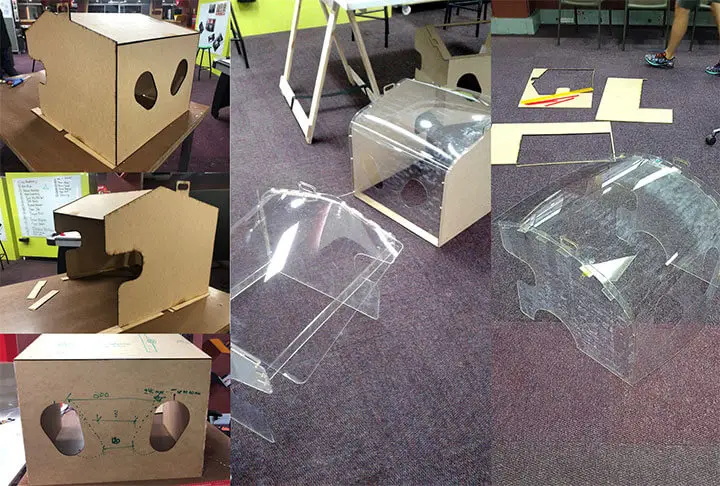
Medical professionals began testing intubation box prototypes developed by REGENT Business School. Once approved, production was set to begin at iLeadLAB facilities in Durban, Johannesburg, Pretoria, and Cape Town.
The project formed part of a larger PPE initiative.
Phase 1
Focused on producing protective masks and face shields for hospitals and relief organisations.
Phase 2
Focused on manufacturing intubation boxes.
Each box was made from PETG, a strong, rigid polyester. PETG was chosen because it is flexible, durable, and easy to cut. This made large-scale production much easier.
The design was based on open-source models being used around the world. However, REGENT didn’t stop there.
The team worked closely with healthcare professionals to improve the design. Several changes were made to increase safety and effectiveness in hospital environments.
Dr Ahmed Shaikh, Managing Director of REGENT Business School, explained that the goal was to donate as many intubation boxes as possible to public healthcare facilities.
These donations were made in addition to thousands of face shields and protective masks already produced by the institution.
This effort became a leading example of REGENT Business School PPE innovation.
The work also supported local manufacturing efforts.
At an Economic Cluster Council briefing, Minister of Trade and Industry Ebrahim Patel praised organisations that were producing PPE locally.
Initiatives like these helped strengthen COVID-19 PPE production in South Africa and support the country’s healthcare system.
Furthermore, the impact reached beyond South Africa.
REGENT also donated PPE to neighbouring countries, including Namibia and Eswatini.
The institution worked closely with partners across Africa as part of the Honoris United Universities COVID-19 response.
One example was Université Centrale in Tunisia. The university developed a non-invasive ventilator to support healthcare workers.
These partnerships showed the value of African institutions working together to solve African challenges.
Throughout the pandemic, REGENT followed a “flatten, fight, future” strategy.
The institution remained committed to helping students, healthcare workers, and communities.
Today, this project stands as an example of higher education innovation during the pandemic in South Africa.
It also shows the power of a business school community’s response to COVID-19 during a national crisis.
Lessons from REGENT’s COVID-19 response
Students and organisations alike can learn a lot from REGENT’s COVID-19 response. Some key lessons include the following:
Innovation can solve real problems
The pandemic showed that innovation is not limited to technology companies. By leveraging its iLeadLABs, REGENT developed practical solutions that helped protect healthcare workers during a national crisis.
Collaboration creates greater impact
The project brought together educators, healthcare professionals, and international partners. Working together helped improve designs, speed up production, and extend support beyond South Africa’s borders.
Business education can drive social change
The initiative demonstrated that business schools can play an active role in solving community challenges. Leadership, problem-solving, and innovation can create meaningful impact both inside and outside the classroom.
FAQs
How much PPE did REGENT donate during the pandemic?
As part of the REGENT Business School COVID-19 response, the institution donated approximately 6,000 face shields and worked to distribute 5,000 protective masks.
PPE was also donated to healthcare facilities and relief organisations across South Africa, Namibia, and Eswatini.
What is the iLeadLAB at REGENT Business School?
The iLeadLAB is REGENT’s innovation hub. It brings together technology, creativity, and problem-solving. Students get to come up with creative and innovative solutions — powerful skills in the job market. Learn more about the iLeadLAB and the benefits it offers.
Did REGENT collaborate with other institutions on its COVID-19 response?
Yes. REGENT worked with healthcare professionals, public organisations, and partners within the Honoris United Universities network. These partnerships helped increase innovation, share knowledge, and expand support across Africa.
How did South African institutions help during COVID-19?
Many organisations stepped forward to support healthcare workers and communities. They produced PPE, donated equipment, supported hospitals, and developed new solutions to help fight the virus.
REGENT’s PPE initiative is one example of how educational institutions contributed during this challenging period.
Study with REGENT
Real leadership is about making a difference.
The work completed through the PPE initiative shows how business knowledge can be used to solve real-world problems.
Through practical and industry-focused programmes, students learn how to lead, innovate, and create positive change.
This commitment to REGENT Business School’s social responsibility continues to shape future business leaders across South Africa and beyond.
Explore our undergraduate and postgraduate programmes.
